
Table of Contents
Modern electronics are about more than silicon; they are about connectivity. While microprocessors and sensors tend to steal the spotlight, the humble connector ensures that power arrives and signals flow intact. Connectors are the gateways through which components, modules and assemblies exchange current and information. They determine how easily a product can be assembled, serviced, upgraded and used. A weak link at any interconnect can disrupt an entire system. Understanding connectors is therefore essential for engineers, product managers and procurement professionals who want to build reliable, scalable hardware.
This article explains how connectors work, why they matter, what factors define their performance, how to integrate them into product architecture, and how to source them responsibly. We also explore emerging trends and finish with a practical call to action.
Introduction — Why Connectors Matter in Electrical Components
A connector is an electromechanical device used to create an electrical connection. Its purpose is deceptively simple: join two terminations so that current and signals flow. Yet behind this simplicity lies an astonishing variety of form factors, material choices and engineering trade‑offs. Connectors enable power distribution, data transfer and control in everything from household appliances and robots to aerospace systems and medical devices. Because connections must be robust, repeatable and safe, connectors play a role disproportionate to their physical size.
Industry categorises connectors in many ways. One common division is by how the connector interfaces with equipment: cable connectors, panel connectors, PCB‑mount connectors and splices. Another classification reflects usage: plugs (often associated with cables) mate with jacks (often mounted on equipment).
Functional categories include power connectors (built for high currents), signal connectors (for data and sensor lines) and control connectors (often for low‑power switching or interfaces). Each of these categories addresses a specific need; there is no single connector that satisfies all requirements.
The decision to select one connector over another shapes assembly processes, reliability, serviceability and even user experience. A $3 connector can destabilise a $3,000 system if chosen poorly. Conversely, a carefully selected connector can simplify assembly, improve performance and extend the life of a product.
In high‑volume consumer devices, connectors enable quick assembly with automated equipment. In mission‑critical systems such as aircraft or robotic surgery, connectors must maintain integrity under vibration, temperature cycles and electromagnetic interference. The stakes are high, and the best connector is not necessarily the most expensive but the most appropriate for the job.
Connector Fundamentals — Types, Contact Systems and Platings
At its core, a connector consists of conductive contacts held in place by insulating materials within a mechanical housing. The contact is made of a conductor with low electrical resistance, high conductivity and sufficient mechanical strength. Common contact materials include copper alloys, brass, phosphor bronze and beryllium copper; these are chosen for their balance of conductivity and elasticity.
To prevent oxidation and reduce contact resistance, contacts are plated with metals such as gold, nickel or tin. Gold is prized for its corrosion resistance and stable contact resistance; nickel provides a hard barrier layer; tin offers affordability but must be thick enough to avoid whisker growth. The insulator, often a thermoplastic like PBT, nylon or LCP, must withstand the heat of soldering or crimping and maintain electrical isolation under voltage and humidity. In hermetic or high‑temperature connectors, fired ceramic insulators may be used.
The housing or shell surrounds the contact system, providing mechanical support, alignment and protection. Materials range from molded plastics for consumer connectors to machined aluminum or stainless steel for rugged and high‑EMI environments. Some housings incorporate gaskets or O‑rings to provide sealing against dust and moisture.
Back-shells and strain reliefs protect the cable‑to‑connector joint from flex and vibration. Many connectors include keying features that prevent mis‑mating; these keys ensure that only the correct plug and receptacle can mate by aligning slots and ribs or asymmetrical shapes. Locking mechanisms, such as latches, bayonet couplings, threaded couplers and jackscrews, ensure the connection remains secure under shock or vibration. These mechanical details may seem minor, but they significantly influence reliability.
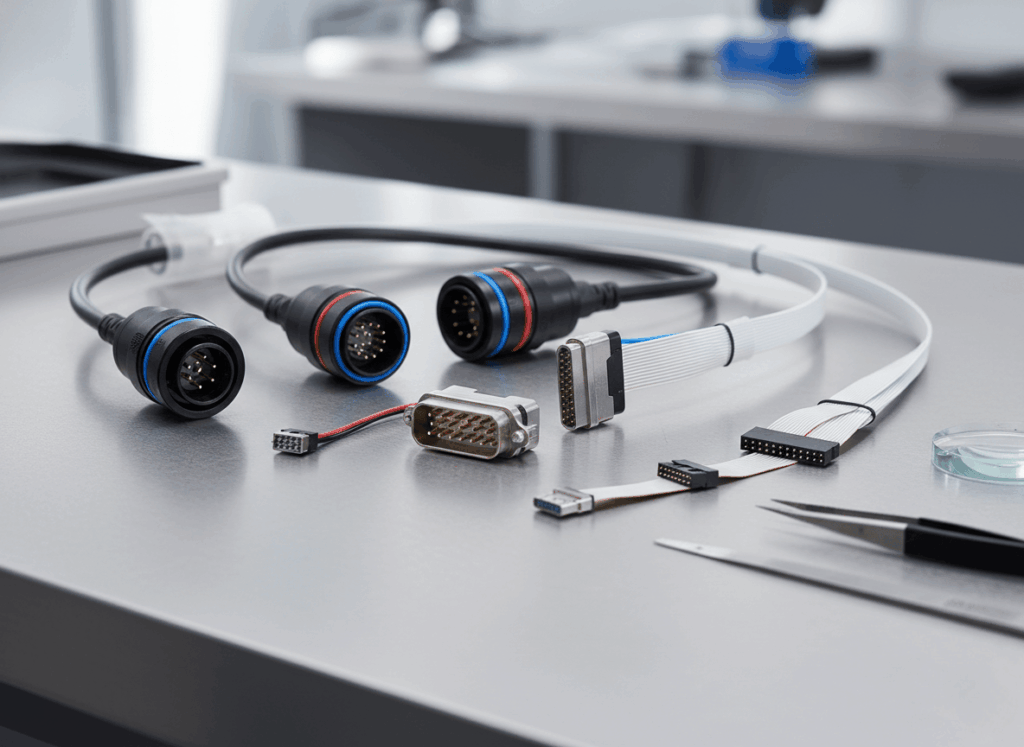
Connectors come in numerous form factors. Common families include:
- Board‑to‑board connectors, which join two printed circuit boards directly (e.g., mezzanine connectors, card‑edge connectors).
- Wire‑to‑board connectors, which attach wire harnesses or discrete wires to PCBs (e.g., IDC, crimp housings, terminal blocks).
- Wire‑to‑wire connectors, for connecting harnesses or cables together (e.g., two‑pin automotive connectors, multi‑pin industrial connectors).
- I/O connectors, for external connections (e.g., USB, HDMI, Ethernet, D‑sub). Some, like USB‑C, support both power and high‑speed data in a reversible design.
- Circular connectors, used in industrial and military applications for their ruggedness and environmental sealing.
- Card connectors, such as SIM or SD card slots, which accommodate removable cards.
Each type presents unique trade‑offs in size, number of contacts, current capacity, data rate, sealing, insertion cycles and cost. When selecting a family, designers must consider not just the electrical specification but the mechanical interface with the surrounding equipment.
Performance Characteristics — Electrical, Mechanical and Environmental Reliability
Connector performance is multi‑dimensional; it encompasses electrical parameters, mechanical properties and environmental resilience.
On the electrical side, current rating is a basic specification. It indicates the maximum current each contact can carry continuously without excessive temperature rise. This rating depends on contact material, plating, size, contact resistance and ambient temperature. Contact resistance is another critical parameter; low resistance means less power loss and heating. Contact resistance should remain stable over thousands of mating cycles, which is why plating integrity matters.
Voltage rating defines the maximum safe voltage the connector can withstand without dielectric breakdown or tracking across insulating surfaces. High‑speed data connectors add specifications for impedance control (typically 50 or 100 Ω) and return loss. These parameters ensure that signals propagate with minimal reflections and crosstalk. With data rates exceeding 10 Gb/s, the geometry of the contacts and the dielectric properties of the insulator play major roles.
Mechanically, insertion force (the force required to mate a connector) and retention force (the force required to keep it mated) must be balanced. Too low a retention force can lead to accidental disconnection; too high a force may make the product difficult to assemble or damage delicate boards.
Mating cycles measure durability; connectors used in consumer products might be rated for a few hundred cycles, while industrial or test connectors may exceed 10 000 cycles. Vibration and shock resistance are especially important for automotive, aerospace and robotics applications. Connectors may incorporate latches, threaded couplers or bayonet systems to secure the connection under dynamic loads.
Environmental factors include temperature range, humidity, dust, liquid ingress and chemical exposure. Many connectors are rated for −40 °C to 85 °C, while those in extreme environments must handle −55 °C to 125 °C or more. Ingress Protection (IP) ratings indicate resistance to dust and water; for example, IP67 means the connector is dust‑tight and can withstand immersion in 1 m of water for 30 minutes. Corrosion is a major cause of connector failure; plating choices, housing material and sealing all affect corrosion resistance. If connectors are used outdoors or near saltwater, stainless steel shells and gold‑over‑nickel contacts offer better longevity.
Notably, connectors are a frequent point of failure in electronic systems. An industry review of connector failures found that open circuits (interruption of continuity) cause about 61 % of connector failures; poor contact causes 23 %, and short circuits cause 16 %. These failures can result from misalignment, vibration loosening, improper mating or insufficient contact force. Designing for mechanical robustness, proper mating cycles and environmental protection mitigates these issues.
Integration in PCB and Product Architecture
Selecting a connector is only part of the engineering challenge; integrating it into the PCB and product architecture is equally crucial. On the PCB, connectors require adequate footprint and keep‑out areas. Designers must check that trace routing, ground planes and mounting holes align with the connector’s pin rows, standoffs and latches. Plated through‑holes or surface‑mount pads must meet the connector manufacturer’s tolerances. High‑current connectors demand thicker copper pour and additional vias to spread heat. For high‑speed signals, routing to the connector must maintain differential pair impedance and minimize stub lengths.
Mechanical clearance is critical. Connectors must not conflict with neighboring components or enclosure features. Board‑to‑board connectors require precise stack height control to ensure contacts are fully engaged. As products get smaller, stacking boards with mezzanine connectors can save space but demands careful mechanical modeling. For wire‑to‑board connectors, cable exit angles and strain relief should align with the enclosure design; otherwise, cables may bend excessively, leading to broken wires.
Serviceability is another design consideration. Connectors used for programming, testing or replacing modules should be easy to access; others may be hidden inside the product. Keying features help avoid connecting harnesses incorrectly. When multiple connectors with similar shapes coexist in a system, color coding or mechanical polarization can prevent mis‑mating. In some cases, connectors must be sealed through bulkhead panels; these require feed‑through connectors with gaskets or flanges.
Electromagnetic performance also influences placement. A connector carrying high‑speed signals should be near the board edge to minimize internal routing and reduce EMI. It may need shielding and proper grounding. Power connectors should be placed near regulators or power entry points to shorten high‑current paths. For connectors used in RF systems, coaxial connectors like SMA or SMB maintain signal integrity through controlled impedance.
Finally, connectors must align with the supply chain. Choosing a connector that requires a long lead time or expensive tooling can jeopardize time‑to‑market. Using widely available families can improve second‑source availability and lower cost. All these integration factors should be considered when designing the PCB and product architecture.
Manufacturing and Sourcing Insights — Tooling, MOQs and Supply‑Chain Realities
Behind every connector is a supply chain that determines availability, cost, quality and flexibility. Many connector styles use proprietary molds and stamping dies owned by the original manufacturer. Consequently, second sources for custom connectors can be limited. When a connector with a unique form factor is chosen, the buyer effectively locks themselves into that supplier, at least for the life of the product. If the supplier raises prices or experiences shortages, the product’s production can stall. Designers and procurement teams should therefore evaluate whether standard connectors exist that satisfy requirements, or at least confirm that multiple manufacturers offer equivalent parts.
Minimum order quantities (MOQs) vary widely across connector families. Standard through‑hole headers may come in reels of 1 000 pieces, while custom-molded connectors might require orders of 5 000 or more. For prototypes, some manufacturers offer short runs or samples, but many will not break packaging. Molding new housings or modifying existing ones can involve expensive tooling; these costs must be amortized over the production volume. Lead times also range from days to months. Simple connectors kept in distribution channels can be delivered quickly. High‑speed board‑to‑board connectors, especially those with many positions and tight tolerances, may require twelve weeks or more.
Supply chain stability is essential. The materials used in connectors (plastics, copper alloys, plating chemicals) may experience price volatility. Political factors, tariffs and environmental regulations can disrupt supply. For example, plating processes using certain chemicals are subject to environmental regulations; changes in these rules can reduce plating capacity and lead to shortages. In addition, counterfeit connectors, parts that superficially resemble brand‑name connectors but lack the same materials and tolerances, pose risks. They may fail prematurely or not fit correctly. Therefore, working with trusted distributors or agents who verify authenticity and quality is critical.
Yana Sourcing navigates these complexities by developing relationships with multiple connector manufacturers and verifying their capabilities. By matching designs to appropriate suppliers and planning procurement ahead of time, they mitigate delays and cost escalations.
Quality and Compliance — Test Methods, Certifications and Traceability
Ensuring connector quality involves both design validation and production inspection. On the mechanical side, tests include insertion/withdrawal force measurements, mating cycle endurance, vibration and shock testing. Contact retention and crimp pull tests confirm that wires will not detach under stress. Thermal cycling subjects connectors to repeated heating and cooling to reveal expansion mismatches or plating micro-cracks. For sealed connectors, water ingress tests verify IP ratings.
Electrical testing measures contact resistance, insulation resistance and dielectric withstand voltage. In high‑speed connectors, time-domain reflectometry (TDR) checks impedance control. Environmental tests expose connectors to corrosive atmospheres; salt spray tests simulate marine environments, and sulfur dioxide chambers replicate polluted atmospheres. Following tests, connectors may be sectioned and examined microscopically for corrosion, plating thickness and mechanical damage.
Compliance involves adhering to standards and regulations. RoHS restricts hazardous substances like lead, cadmium and mercury. REACH governs the use of chemicals in manufacturing. Many industries have connector-specific standards: automotive connectors must meet USCAR requirements; aerospace connectors follow MIL‑DTL or ARINC specifications. UL and CSA certifications ensure products have been tested for flammability, electrical safety and mechanical strength. Connectors used in medical devices may need to meet ISO 13485 quality management requirements or IEC 60601‑1 for electrical safety. Traceability of materials and production batches is also important; if a defect is discovered, manufacturers need to identify affected lots and implement corrective action.
Ensuring compliance is not just a regulatory requirement; it reduces liability, ensures safety and enhances brand reputation. Yana Sourcing audits its connector suppliers for certifications and provides documentation to clients to support CE or UL marking.
Emerging Innovations and Future Trends
Connector technology continues to evolve, driven by higher data rates, increased power density, miniaturization and sustainability. Some of the notable trends include:
- High‑Speed and High‑Density Interconnects: Data rates above 10 Gb/s require connectors with precisely controlled impedance and minimal skew. New board‑to‑board connectors support differential signaling at 25 Gb/s per lane. These connectors often use shorter contacts, advanced plastics with low dielectric constant and integrated shielding to minimize crosstalk and EMI.
- Hybrid Connectors: To reduce the number of separate connectors and the associated space, hybrid connectors combine power, signal and sometimes fluid channels in a single housing. They can carry high current, digital data and sometimes optical signals through separate sub‑contacts. Hybrid connectors simplify assembly and enable modularity.
- Tool‑less and Snap‑Fit Designs: Consumer devices favour connectors that can be mated without special tools. Examples include FFC/FPC connectors with push‑fit or flip‑lock mechanisms and miniature board‑to-board connectors with latching features. In industrial and medical applications, quick-release mechanisms facilitate rapid servicing.
- Magnetically-Keyed Connectors: Magnetic connectors, popularized by laptop charging ports, align themselves via magnets and detach easily if the cable is pulled. They reduce wear on the port and protect the board from damage. Similar concepts are appearing in wearable devices and medical equipment.
- Environmentally Friendly Materials: Regulations and sustainability initiatives are driving the adoption of lead-free and halogen-free materials and greener plating processes. Alternative plating chemistry reduces reliance on toxic substances like cyanide. Additionally, connector housings are moving toward recyclable or bio-derived plastics.
- Smart Connectors: Some connectors include integrated chips to monitor contact conditions (e.g., temperature, current, mating cycles) and report this data for predictive maintenance. Others incorporate ID chips to authenticate devices or communicate configuration data.
These innovations increase functionality but also complexity. Staying informed allows engineers to leverage new capabilities while avoiding pitfalls associated with first-generation technologies.
Choosing the Right Connector for Your Application
Selecting a connector begins with defining requirements. Start with the basics: number of positions, current per contact, voltage rating and data rate if carrying signals. Then consider environmental conditions such as temperature range, moisture exposure and vibration. Evaluate mechanical constraints like available space, mating cycles, insertion and withdrawal force, and required retention force. Serviceability matters: a connector that must be disconnected frequently needs higher cycle life and easy access. Plating choice depends on cost and environment, tin plating suffices for controlled environments with infrequent mating, while gold is better for frequent or critical connections.
The product’s assembly process influences connector choice. For example, IDC (insulation displacement connectors) are easy to assemble in high volume and reliable when installed properly. Crimped contacts require quality tools and processes to achieve reliable terminations. Solder‑type connectors can be cheap but introduce thermal stress to wires. If a connector is hidden within a sealed unit, a cheaper mating interface may suffice; if it is user-facing, aesthetics and tactile feedback may matter.
Lock-in risk is a consideration often overlooked. A connector that looks like a standard may have proprietary dimensions or contact pitch, making substitutes incompatible. Choosing a vendor with second sources or using widely recognized families (e.g., JST, Molex MicroFit, TE Connectivity MicroMatch) can safeguard supply. Finally, factor in cost not just per unit but across the lifecycle. A connector that is cheaper but fails more often can incur warranty costs, recalls and brand damage. Conversely, overspecifying a connector adds unnecessary cost and volume. The right connector balances performance, durability and cost.
Sourcing Verified Electrical Connectors with Yana
Yana Sourcing specializes in bridging the gap between design requirements and supplier capabilities. In an increasingly complex supply chain, Yana acts as a technical advisor, quality inspector and logistics coordinator. Rather than simply forwarding quotes, Yana evaluates your design, advises on connector choices and identifies reliable manufacturers. The team reviews supplier certifications and audits production lines. They ensure that contacts are made from specified alloys, that plating thickness meets standards, and that insulators can withstand processing temperatures. Yana also checks mechanical features like keying and locking mechanisms and ensures that housings and back-shells are properly sealed.
Beyond verification, Yana helps negotiate MOQs, plan for lead times and build buffer strategies. They coordinate incoming inspection and deliver sample connectors for your own testing. Once production starts, Yana monitors shipments, consolidates orders with other components, and handles customs documentation. If a part requires traceability, Yana works with manufacturers to provide lot numbers and test reports. In case of supply disruptions, Yana can source equivalent connectors or adjust production schedules. By handling the details, Yana frees your team to focus on design and product development while maintaining supply chain resilience.
Call to Action — You Are Not Alone
Sourcing connectors is about more than price. It involves technical evaluation, quality assurance and risk management. A trusted partner like Yana Sourcing brings expertise across engineering, quality and logistics, turning a complex supply chain into a competitive advantage. By focusing on fundamentals and partnering with professionals, you can build electronics that are not only functional but reliable, compliant and ready for the future.
If you’re in the early design phase, optimizing an existing connector family, or evaluating new suppliers, we’re here to support you. Share your requirements or even just your constraints, and we’ll help you define the clearest next step. Contact Yana Sourcing.