
Table of Contents
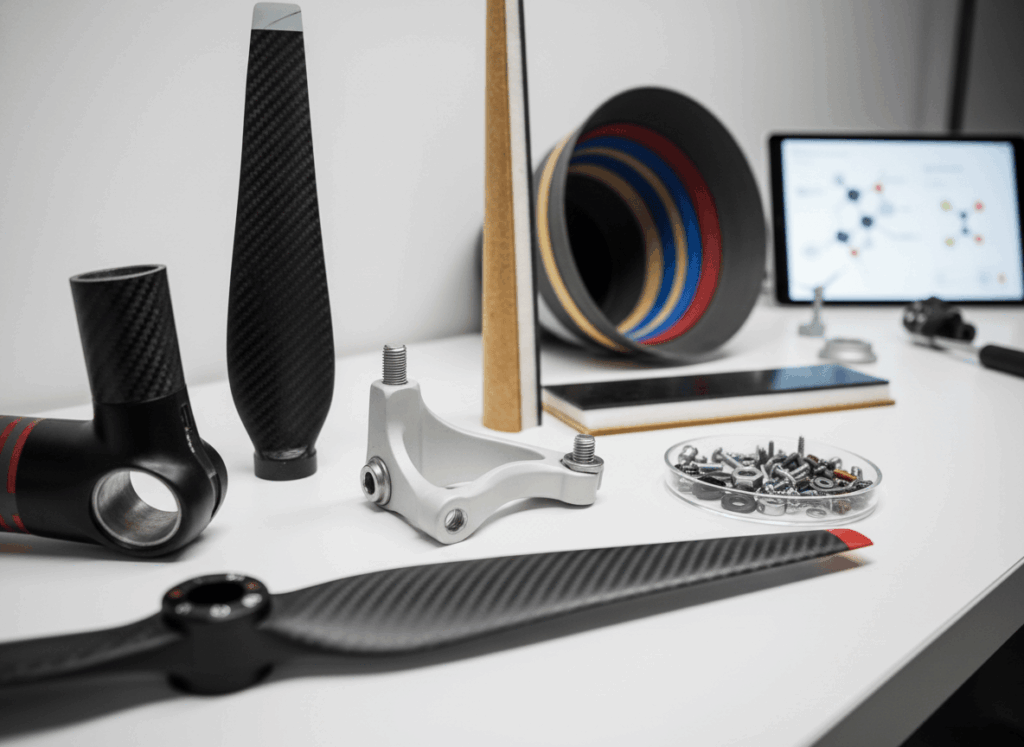
Engineering composites combine the best of multiple worlds, the stiffness of metals, the resilience of polymers, and the precision of advanced fibers.
They’re not a single material but a design philosophy: tailor strength where it’s needed, remove weight where it’s not.
From aerospace and automotive to sports, robotics, and architecture, composites represent the art of balancing structure, flexibility, and sustainability.
As supply chains shift toward energy efficiency and recyclability, composite materials have become the defining medium of modern engineering.
Key Properties of Engineering Composites
What makes engineering composites revolutionary isn’t a single property, it’s their tunability.
Unlike metals or polymers, whose properties are fixed by chemistry, composites are engineered from the ground up.
By selecting the right combination of fibers, matrix, and orientation, engineers can design materials that act differently in every direction, achieving strength where it matters and flexibility where it’s needed.
This design freedom makes composites the go-to choice for industries chasing lightweight performance, corrosion resistance, and durability, from aircraft fuselages to robotic arms.
High Strength-to-Weight Ratio
Perhaps the defining advantage of engineering composites is their exceptional strength relative to weight.
The reinforcement fibers, carbon, glass, aramid, or basalt, carry the mechanical load, while the resin matrix distributes stress and holds them in place.
| Material | Density (g/cm³) | Tensile Strength (MPa) | Strength-to-Weight Index |
|---|---|---|---|
| Aluminum Alloy | 2.7 | 400–500 | 1.0 |
| Steel | 7.8 | 800–1,200 | 0.4 |
| CFRP (Carbon Fiber Reinforced Polymer) | 1.6 | 1,000–2,000 | 2.0–3.0 |
| GFRP (Glass Fiber Reinforced Polymer) | 1.9 | 500–900 | 1.5–2.0 |
Carbon fiber composites, for instance, achieve twice the strength of aluminum at half the weight, a property critical in aerospace, automotive, and sports design.
By reducing structural weight, engineers unlock energy savings, higher speed, and longer service life.
Tailored Anisotropy
Unlike isotropic metals, engineering composites can be anisotropic, their strength varies by direction.
This is not a limitation; it’s a design advantage.
By aligning fibers along load paths, composites can be optimized to handle stress efficiently while eliminating excess material.
Example:
A robotic arm made of carbon fiber laminates can be 40% lighter and still withstand the same bending moment as an aluminum arm, simply by orienting fibers in ±45°, 0°, and 90° plies.
| Fiber Orientation | Typical Use | Property Emphasis |
|---|---|---|
| 0° | Axial load-bearing | Tensile strength |
| ±45° | Shear load | Torsional stiffness |
| 90° | Transverse stability | Impact resistance |
This directional strength tailoring is the hallmark of engineering composites, materials designed, not discovered.
Corrosion and Fatigue Resistance
Unlike metals, which corrode or fatigue under cyclic stress, engineering composites are inherently resistant to both oxidation and mechanical degradation.
The polymer matrix acts as a protective barrier against moisture, salt, and chemicals, while the fiber reinforcement resists crack propagation.
| Property | Typical Composite Range | Comparison |
|---|---|---|
| Fatigue Life (10⁶ cycles) | 60–90% of initial strength | Metals: 30–50% |
| Corrosion Resistance | Excellent | No oxidation or galvanic corrosion |
| Environmental Durability | Excellent | UV- and moisture-resistant with coatings |
This makes composites ideal for marine, offshore, and chemical environments, where metal fatigue and rust would normally limit lifespan.
In aircraft and EV frames, fatigue resistance translates to longer maintenance intervals and fewer structural inspections.
Thermal and Electrical Customization
Another defining feature of engineering composites is that they can be tuned to either conduct or insulate heat and electricity, something metals cannot do flexibly.
- Carbon fiber composites are electrically conductive, ideal for lightning protection, EMI shielding, and heat dissipation.
- Glass fiber composites are insulating, perfect for electrical housings or structural components near sensitive electronics.
- Hybrid laminates can integrate both properties, for instance, conductive carbon layers outside and insulating glass layers inside.
| Composite Type | Thermal Conductivity (W/m·K) | Electrical Conductivity | Typical Use |
|---|---|---|---|
| CFRP | 5–10 | Conductive | Aerospace, electronics |
| GFRP | 0.3–0.5 | Insulating | Power systems, marine |
| Hybrid (CFRP+GFRP) | 1–3 | Controlled | EV battery protection |
The ability to engineer conductivity profiles gives composites a unique role in modern electrification and digital hardware, balancing safety, signal stability, and weight.
Major Types of Engineering Composites
There is no single “composite material.”
Instead, engineering composites form an entire spectrum of material systems, each built from a matrix (polymer, metal, or ceramic) and a reinforcement (fiber, particle, or fabric).
Each combination brings its own balance of strength, cost, manufacturability, and environmental profile.
Below are five families that define the modern composite landscape.
Carbon Fiber Reinforced Polymer (CFRP)
Carbon fiber composites represent the pinnacle of strength-to-weight optimization.
Made from high-modulus carbon fibers embedded in an epoxy or thermoplastic matrix, CFRPs deliver stiffness, fatigue resistance, and a futuristic aesthetic.
| Property | Typical Value | Comparison |
|---|---|---|
| Density | 1.5–1.7 g/cm³ | ~40% of aluminum |
| Tensile Strength | 800–2,000 MPa | 2–4× stronger than aluminum |
| Elastic Modulus | 70–200 GPa | Comparable to steel |
| Service Temperature | up to 200°C | Higher with PEEK matrix |
Applications:
- Aerospace fuselage and wing panels
- Electric vehicle monocoques and battery enclosures
- Robotics arms and end-effectors
- Sporting equipment (bicycles, rackets, drones)
Advantages: unmatched stiffness and low weight.
Limitations: high cost and complex recycling, though thermoplastic CFRPs are now improving reusability.
Glass Fiber Reinforced Polymer (GFRP)
Glass fiber composites are the workhorse of the industry, offering a balance between cost, strength, and manufacturability.
They combine E-glass or S-glass fibers with polyester, vinyl ester, or epoxy matrices to create versatile and durable laminates.
| Property | Typical Value | Comparison |
|---|---|---|
| Density | 1.8–2.0 g/cm³ | ~70% lighter than steel |
| Tensile Strength | 500–1,000 MPa | Lower than CFRP, higher than aluminum |
| Flexural Modulus | 20–40 GPa | Sufficient for semi-structural parts |
| Temperature Range | -40 → +150°C | Stable for industrial use |
Applications:
- Boat hulls, wind turbine blades, and bridge decks
- Pipes, tanks, and chemical plant components
- Electrical housings and insulation panels
Advantages: low cost, corrosion resistance, easy processing (RTM, pultrusion).
Limitations: lower stiffness than carbon, glass fiber dust handling requirements.
Aramid (Kevlar®) Composites
Aramid composites, based on Kevlar® or Twaron® fibers, are known for impact resistance and energy absorption.
Their para-aramid fiber structure gives them superior toughness compared to both carbon and glass fibers, making them essential for applications requiring protection or flexibility.
| Property | Typical Value | Key Advantage |
|---|---|---|
| Density | 1.4 g/cm³ | Ultralight |
| Tensile Strength | 2,500–3,000 MPa | Extremely strong in tension |
| Impact Resistance | Outstanding | High ballistic energy absorption |
| Elastic Modulus | 60–120 GPa | Flexible yet strong |
Applications:
- Aerospace and automotive safety structures
- Protective gear, helmets, tires, ropes
- Robotics joints and damping components
Advantages: highest toughness-to-weight ratio.
Limitations: UV sensitivity and moisture absorption, often hybridized with carbon or glass to overcome this.
Metal Matrix Composites (MMC)
Metal matrix composites combine the ductility of metals with the stiffness of ceramics or fibers.
Common matrices include aluminum, magnesium, or titanium reinforced with silicon carbide (SiC), boron, or alumina (Al₂O₃) particles or fibers.
| Property | Typical Range | Unique Feature |
|---|---|---|
| Density | 2.5–3.0 g/cm³ | Still lighter than steel |
| Tensile Strength | 500–1,200 MPa | High specific strength |
| Elastic Modulus | 100–250 GPa | Adjustable with ceramic content |
| Thermal Conductivity | High (100–200 W/m·K) | Ideal for heat sinks and engines |
Applications:
- Automotive brake rotors, pistons, and connecting rods
- Aerospace structures and satellite panels
- Robotics actuators and wear-resistant joints
Advantages: temperature stability, wear resistance, electrical conductivity.
Limitations: expensive processing and limited formability, often produced via powder metallurgy or squeeze casting.
Natural Fiber and Bio-Composites
As sustainability becomes core to material innovation, natural fiber composites are gaining ground.
Using flax, hemp, jute, or bamboo fibers embedded in bio-resins or recycled polymers, these materials balance mechanical performance with environmental responsibility.
| Property | Typical Value | Environmental Impact |
|---|---|---|
| Density | 1.2–1.4 g/cm³ | Extremely light |
| Tensile Strength | 100–400 MPa | Adequate for non-structural use |
| CO₂ Footprint | 60–80% lower vs synthetic | Renewable and biodegradable |
| Moisture Absorption | Moderate | Improved with coatings |
Applications:
- Automotive interior panels and dashboards
- Furniture, construction, and packaging
- Consumer goods emphasizing eco-design
Advantages: renewable, low embodied energy, acoustic damping.
Limitations: inconsistent fiber quality and moisture sensitivity, mitigated with surface treatments or hybrid layering.
Manufacturing and Processing Techniques
The value of engineering composites doesn’t just come from their ingredients — it’s unlocked through how they’re made.
Unlike metals that are melted and cast, composites are constructed layer by layer, cured under precise heat and pressure.
Processing defines not only cost, but also fiber alignment, void content, dimensional accuracy, and mechanical integrity.
Below are the most widely used manufacturing techniques shaping today’s composite revolution.
Hand Lay-Up and Vacuum Bagging
Hand lay-up remains the simplest and most flexible method for producing custom composite parts in low to medium volumes.
Layers of fiber fabric (carbon, glass, or aramid) are manually placed into a mold and impregnated with resin.
After stacking, the laminate is vacuum bagged to remove air pockets and compact the layers during curing.
| Parameter | Typical Value | Advantage |
|---|---|---|
| Pressure | ~0.8 bar (vacuum) | Removes voids, increases fiber volume fraction |
| Cure Temperature | 50–120°C | Depends on resin system |
| Fiber Volume Fraction | 40–55% | Moderate structural quality |
Use Cases:
- Aerospace interior panels
- Marine components and sporting goods
- Prototype or custom parts
Pros: simple setup, low tooling cost.
Cons: labor-intensive, limited repeatability.
Despite being manual, when combined with vacuum bagging, this method achieves excellent surface finish and dimensional accuracy for complex geometries.
Resin Transfer Molding (RTM) and Prepreg Autoclaving
For high-performance structural parts, manufacturers turn to Resin Transfer Molding (RTM) or prepreg autoclave processes.
- RTM injects resin into a closed mold containing dry fiber reinforcement.
It enables consistent fiber wet-out and precision control — ideal for automotive, aerospace, and wind-energy applications. - Prepreg Autoclaving uses fibers pre-impregnated with resin and partially cured (“B-stage”).
Layers are stacked and cured in an autoclave at 120–180°C and 5–7 bar pressure, ensuring minimal voids and aerospace-grade quality.
| Process | Pressure | Key Benefit | Application |
|---|---|---|---|
| RTM | 3–6 bar | Accurate fiber placement, smooth surface | EV body panels, UAVs |
| Prepreg + Autoclave | 5–7 bar | High fiber fraction, superior bonding | Aerospace primary structures |
| Out-of-Autoclave (OOA) | 1 bar (vacuum) | Reduced cost, comparable strength | Large composite shells |
These methods yield CFRP parts with >60% fiber content, low porosity, and flawless reproducibility, the gold standard for aircraft, satellites, and premium automotive applications.
Pultrusion and Filament Winding
When the goal is continuous strength and geometric precision, pultrusion and filament winding dominate.
- Pultrusion: continuous fibers are pulled through a resin bath and heated die, forming constant cross-section profiles, such as beams, rods, or structural channels.
- Filament Winding: fibers are wound under tension onto rotating mandrels, allowing precise fiber orientation (±θ°) and automated production.
| Process | Fiber Orientation | Ideal Application |
|---|---|---|
| Pultrusion | 0° (axial) | Structural beams, cable trays, ladders |
| Filament Winding | ±45°, 90°, 0° | Pressure vessels, pipes, tanks, flywheels |
Advantages:
- High repeatability and continuous throughput
- Excellent dimensional control
- Automated production at low waste rates
Limitations:
- Restricted to linear or rotational geometries
- Less suited for complex free-form shapes
Both methods exemplify how engineering composites merge mechanical precision with manufacturing scalability.
Additive and Hybrid Fabrication
As digital manufacturing evolves, 3D printing and hybrid fabrication are transforming how composites are built.
Continuous fiber additive manufacturing (CFAM) embeds carbon or glass fibers within printed thermoplastic matrices (like PA, PEEK, or PEKK).
Meanwhile, hybrid fabrication merges metal and composite technologies, bonding CFRP skins to aluminum cores or printing polymer matrices onto titanium lattice structures.
| Technology | Key Feature | Emerging Use |
|---|---|---|
| CFAM (Continuous Fiber 3D Printing) | Integrates load-bearing fibers | Robotics, UAV frames |
| Hybrid Metal–Composite Structures | Combines stiffness & conductivity | Aerospace brackets, EV battery trays |
| Automated Fiber Placement (AFP) | Robotic fiber laying precision | Aircraft fuselage and wind blades |
These methods deliver digitally optimized, topology-driven structures, lightweight yet strong enough for aerospace, energy, and automation industries.
They also support mass customization, a hallmark of next-generation manufacturing.
Performance vs Cost and Sustainability
When engineers evaluate engineering composites, the discussion quickly goes beyond tensile strength or weight.
It becomes a question of lifecycle value, how well a material performs, endures, and sustains its impact over time.
Composites excel in performance but demand scrutiny in cost, recyclability, and environmental footprint.
Understanding these trade-offs is essential to making smart sourcing and design decisions.
Lifecycle Efficiency and Weight Reduction
The single biggest performance lever of engineering composites is their ability to cut weight without sacrificing stiffness or safety.
Every kilogram saved in an aircraft can remove hundreds of kilograms of CO₂ over its operational life.
Similarly, lighter vehicles and wind blades translate directly into energy savings.
| Sector | Typical Weight Reduction | Impact |
|---|---|---|
| Aerospace | 20–50% vs aluminum | Lower fuel consumption, higher payload |
| Automotive | 30–40% vs steel | Increased EV range, reduced emissions |
| Wind Energy | 30% lighter blades | Larger rotor diameters, more power |
| Robotics | 40–60% lighter arms | Faster acceleration, lower energy draw |
Even though composites may cost 2–5× more per kilogram, their weight-based performance efficiency often cuts overall system cost, particularly where energy use or maintenance dominates lifecycle expense.
Recyclability Challenges and Fiber Recovery
While engineering composites lead in performance, end-of-life management remains their Achilles’ heel.
Thermoset resins, once cured, cannot be remelted — making traditional recycling impossible.
However, three main recovery routes are emerging:
- Mechanical Recycling — grinding cured parts into filler or reinforcement for lower-grade composites.
- Thermal (Pyrolysis) — heating in inert atmospheres to recover carbon fibers, retaining up to 90% of tensile strength.
- Chemical (Solvolysis) — dissolving resin in supercritical fluids to reclaim both fibers and resins.
| Method | Fiber Recovery Efficiency | Economic Viability | Environmental Impact |
|---|---|---|---|
| Mechanical | 50–60% | Low | Low |
| Thermal (Pyrolysis) | 85–90% | Medium | Moderate energy demand |
| Chemical (Solvolysis) | 90–95% | High | Low with closed-loop solvents |
Hybrid approaches now combine reclaimed carbon fiber with bio-based epoxy, signaling the birth of second-generation composites, strong, circular, and sustainable.
Environmental Regulations and Circular Design
Regulatory frameworks increasingly treat composites not just as performance materials but as environmental liabilities if unmanaged.
Global initiatives are driving recyclability, traceability, and lower VOC emissions during production:
- EU Circular Economy Action Plan — mandates recycling targets for wind turbine blades and automotive composites.
- ISO 14040 / 14044 — lifecycle assessment (LCA) standards for carbon and energy footprint evaluation.
- REACH & RoHS — restrict hazardous resin additives and promote non-toxic catalysts.
- End-of-Life Vehicle Directive (ELV) — pushes for >85% material recovery in transport components.
Next-generation composite design now includes disassembly planning, using thermoplastic matrices or reversible adhesives that allow fiber reclamation without structural compromise.
Comparing Composites with Metals and Polymers
In sourcing and design decisions, it’s not just about “which is stronger”, it’s about where the material wins.
Here’s a simplified comparison of engineering composites against metals and advanced polymers:
| Property | Composites | Metals (Al/Steel) | Polymers (Engineering) |
|---|---|---|---|
| Strength-to-Weight Ratio | ★★★★★ | ★★☆☆☆ | ★★☆☆☆ |
| Fatigue & Corrosion Resistance | ★★★★★ | ★★☆☆☆ | ★★★☆☆ |
| Formability | ★★☆☆☆ | ★★★★★ | ★★★★☆ |
| Recyclability | ★★☆☆☆ | ★★★★★ | ★★★★☆ |
| Thermal Stability | ★★★★☆ | ★★★★★ | ★★☆☆☆ |
| Cost Efficiency (Lifecycle) | ★★★★☆ | ★★★☆☆ | ★★★☆☆ |
| Sustainability (Evolving) | ★★★★☆ | ★★☆☆☆ | ★★★★☆ |
Composites may require more capital investment upfront but yield superior total cost of ownership through lower mass, reduced maintenance, and longer operational life.
Real-World Applications and Case Studies
Every major industrial revolution has been defined by its materials, iron for the 19th century, aluminum for the 20th, and engineering composites for the 21st.
Their ability to combine strength, precision, and sustainability is reshaping how we design vehicles, structures, and machines.
Below are key sectors where composites are not just improving performance but redefining what’s possible.
Aerospace and Aviation Structures
Few industries showcase the potential of engineering composites like aerospace.
Aircraft and spacecraft demand maximum stiffness with minimum weight, along with resistance to fatigue, vibration, and temperature extremes.
Implementation:
- Carbon Fiber Reinforced Polymer (CFRP) is now standard in fuselage panels, wings, and control surfaces.
- Aramid composites serve in radomes and ballistic shields for impact resistance.
- Glass fiber composites are used for interior panels and ducts where cost efficiency matters.
Impact:
- Weight reduction up to 50% compared to aluminum.
- Fuel savings of 15–20% across long-haul aircraft.
- Lower maintenance cycles due to fatigue resistance.
Example:
The Boeing 787 Dreamliner and Airbus A350 use >50% composite by weight, marking the shift from “metal aircraft” to “engineered structure.”
Electric Vehicle Body Panels and Frames
In the electric mobility era, the challenge isn’t horsepower, it’s range and efficiency.
Every gram saved extends a battery’s reach.
This makes engineering composites an ideal substitute for steel and aluminum in structural, aesthetic, and protective components.
Applications:
- CFRP roof shells, hoods, and door frames
- GFRP bumpers and underbody protection
- Composite battery trays and insulation covers
Impact:
- Weight savings of 25–40%
- Improved crash energy absorption
- Electrical insulation and corrosion resistance
Emerging trend:
Automotive OEMs are exploring thermoplastic composites for recyclable EV architectures, merging high volume production with sustainability goals.
Robotics and Industrial Automation
In robotics, every millisecond counts — and every gram matters.
Light, rigid, and fatigue-resistant engineering composites enable faster actuation, longer reach, and lower energy use in automation systems.
Applications:
- Carbon fiber robotic arms, links, and joints
- Composite gear housings and end-effectors
- Hybrid CFRP–aluminum actuators for high-speed pick-and-place
Impact:
- Mass reduction by up to 60%
- Moment of inertia lowered by 45%, improving control accuracy
- Damping of vibration and noise in precision assembly
Composite components are also electrically customizable, allowing insulation near sensors and conductivity for grounding, a rare combination that metals cannot easily achieve.
Sporting Equipment and Consumer Innovation
Where performance meets perception, composites deliver both function and emotion.
Their balance of strength, flexibility, and aesthetics has redefined what consumers expect from premium products.
Applications:
- Carbon fiber bicycles, tennis rackets, and skis
- Aramid-reinforced helmets and protective gear
- Glass-fiber composite drones, boats, and surfboards
Impact:
- Enhanced stiffness and energy return
- Reduced vibration and improved ergonomics
- Unique textures and finishes that signify advanced design
Beyond sports, composite casings are now used in smartphones, laptops, and wearables, merging mechanical protection with lightweight design.
Conclusion — Designed for Performance, Built for the Future
The story of engineering composites is the story of intent over inheritance.
Where metals were discovered, composites are designed, created to meet exact needs in strength, weight, and sustainability.
Every layer, fiber, and resin choice reflects deliberate engineering, not geological luck.
From aerospace to robotics, composites prove that the future of materials lies in precision manufacturing and multi-material intelligence.
They embody the shift from mass to mastery, materials that no longer just exist, but perform by design.
As industries move toward carbon neutrality and digital fabrication, composites will remain the foundation of this transformation: lighter, smarter, and infinitely adaptable.
The next generation of innovation won’t be forged, it will be engineered layer by layer.
Get Expert Support
Selecting the right engineering composite isn’t just about picking a fiber or resin, it’s about balancing mechanical, thermal, and economic factors across the full product lifecycle.
Send us your drawings, load targets, or performance specifications, and our engineering team will help identify the optimal composite system, from CFRP and GFRP to hybrid and bio-composite architectures.
All materials are verified against ASTM, ISO, and DIN standards, ensuring consistency, traceability, and long-term reliability.
📩 Contact Yana Sourcing today to build lighter, stronger, and more sustainable products, powered by next-generation engineering composites.